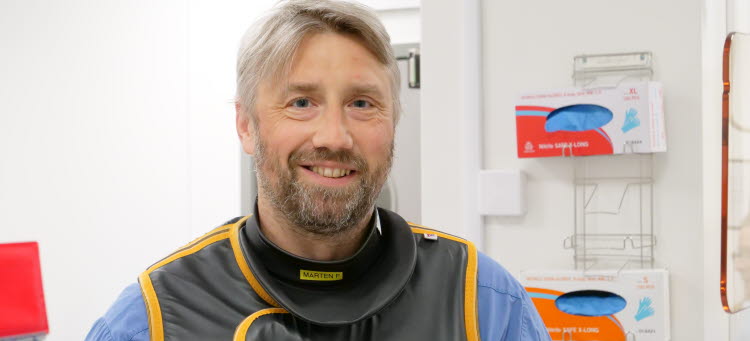
Meet Mårten Forssén, Senior consultant in radiology
Mårten Forssén works as a radiologist at the radiology department at Kalmar County Hospital and has done so for the past 10 years.
– I work a lot with patients and with procedures. That is, inserting catheters into blood vessels and using balloons to widen narrowed sections of vessels. We block blood vessels, stop bleeding, or similar things. We also work with the bile ducts, urinary tract, and drainage of other infected areas, says Mårten.
Radiology was not an obvious choice at first; Mårten entered the field through an elective placement in imaging, combined with the presence of good colleagues at the radiology department who enjoyed their work—and that enthusiasm was contagious.
What attracts you to working as a doctor in radiology?
– I work in a subcategory of radiology that is more focused on interventions, and when it came to that aspect, I gradually realized that I found it enjoyable. More generally, what interested me about radiology from the beginning is that it is quite broad and requires knowledge of anatomy, physiology, and pathology, as well as different organ systems and specialties. At a hospital of this size, we are oriented toward several different departments and need to know a bit of everything.
How would you describe the workplace and your colleagues?
– We have a pleasant workplace. It’s a good size—not too big. You can talk to everyone, and there’s no internal hostility in any way. The biggest drawback is probably that we have relatively few windows—but then again, it is radiology. Otherwise, it’s a good workplace, says Mårten with a smile.
Mårtens main duties involve interventional procedures using catheters and guidewires, but given the size of the hospital, he also needs to review imaging studies from time to time. This involves interpreting CT scans and plain X-rays, as well as preparing for various rounds with other departments. Multidisciplinary conferences must also be prepared and conducted.
Do you work a lot across departmental boundaries, i.e., with other clinics or units?
– Yes, I would say so. Even though we are usually physically based in our own department, we are in contact with all others. We receive referrals from gynecology, primary care, vascular surgery, geriatrics, and more. That means we need to communicate both with patients and referring physicians, as well as with the wards regarding patient transport, preparation, and follow-up care. Sometimes we also move around—for example, if an ultrasound is needed in the ICU or if we need to place a drain in a patient who cannot come to the radiology department.
Why do you think someone should work at your department?
– Most people here seem to think it’s a pleasant workplace. People find it fairly easy to work together here, and there’s a common misconception that we just sit and look at images—but there’s much more to it. There’s a great deal of variation in the work. For me, the size of the hospital was also important, and I think we have an advantage compared to both smaller and larger hospitals. You get to maintain breadth while also having the opportunity to go deeper in certain areas.
Mårten explains that radiology is a technology-oriented specialty with large, expensive equipment, and that the radiology department is currently in an expansion phase. The equipment fleet is being extended with both PET/CT and a new MRI scanner. There are also plans to upgrade the angiography lab, which will result in a broader range of examinations and may enable the department to perform procedures that were previously difficult to carry out.